
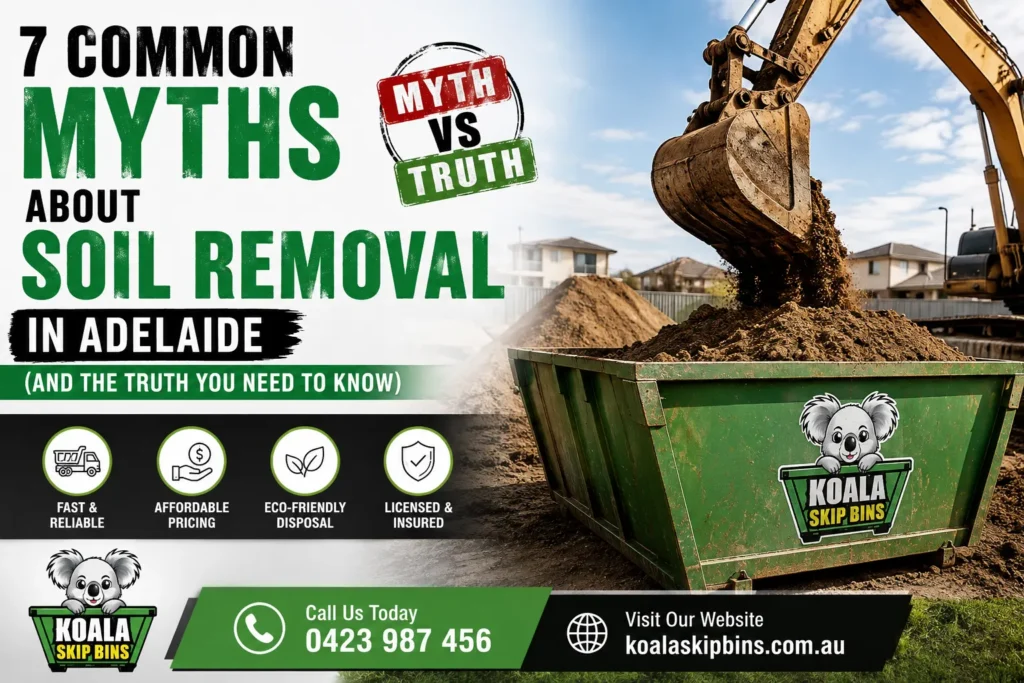
7 Common Myths About Soil Removal in Adelaide (And the Truth You Need to Know)
If you’re planning a landscaping project, a home renovation, or a commercial build-out, the soil removal Adelaide homeowners and builders depend on is rarely as straightforward as it seems. Excavated dirt, clay, and rubble pile up pretty fast, and misinformation on what to do with it seems to stack up just as quickly, too.
At Koala Skip Bins, we handle excavated soil removal Adelaide-wide every week, from little backyard garden beds right through to big commercial excavation sites. Along the way, we’ve heard pretty much every myth going, you know the ones. Some of those misunderstandings end up costing people money. Others can trigger fines, cause project delays, or lead to environmental harm. This guide is meant to clear things up about the seven myths we hear most often, and it’ll give you the real version so your next project stays on track.
Myth 1: “All Soil Is the Same, So Any Bin Will Do”
The truth: Soil type determines the equipment, permits, and disposal pathway you need.
Not all dirt behaves the same once it’s out of the ground, y’know. Clay and the dirt removal Adelaide contractors do day to day is not quite the same as moving light garden loam. Clay compacts, holds on to water, and it’s also notably heavier by volume than topsoil, and that matters because skip bins are priced and rated by weight, not just space or volume.
A general waste skip bin isn’t really meant for soil. Soil typically needs a dedicated skip bin for soil Adelaide services provide, sort of engineered around the actual load and in compliance to the weight limits that local waste facilities set. If you use the wrong bin size, or the wrong type for dense clay, you can run into issues like:
- Overloading fees at the tip
- A bin that’s physically too small for the tonnage
- Delays because the truck can’t safely lift an overloaded bin
Takeaway: Tell your provider what you’re removing clean topsoil, clay, construction fill, or mixed rubble before you book. It changes the bin size and price.
Myth 2: “You Can Just Dump Excess Soil Anywhere on Your Property”
The truth: Uncontrolled soil dumping, even on your own land, can trigger council penalties and drainage problems.
This is one of the most persistent myths in excess soil disposal. Property owners often assume that because the soil came from their land, they can pile it up wherever they like — behind the shed, along a fence line, in a low corner of the yard. In practice, this creates real problems:
- Drainage disruption: Big soil mounds can kinda push stormwater runoff away, but it may impact your place and also your neighbours, and if it goes wrong it could also break the council stormwater rules or whatever.
- Contaminated fill risk: Soil taken from renovation sites can bring along leftover stuff from old paint, treated timber, or asbestos containing materials especially in houses built before the 1980s. When it stays in some sort of heap, just like that, it becomes an exposure risk, quietly but steadily.
- Council compliance: Many South Australian councils end up regulating significant earthworks and fill placement ,even on private property, particularly when its near boundaries or those heritage listed areas, so it can feel a bit indirect at times.
Takeaway: Site clean-up Adelaide standards exist for a reason. If you’re not reusing soil productively (like backfilling or garden bed building), get it removed and disposed of through a licensed provider rather than stockpiling it.
Myth 3: “Soil Disposal Is Always Expensive”
The truth: Pricing depends on volume, soil type, and access and there are genuinely affordable options.
A lot of people assume dirt removal is a premium service reserved for large construction sites. In reality, affordable soil removal Adelaide options exist for jobs of every size. The main cost drivers are:
| Factor | Impact on Price |
| Volume (cubic metres) | Larger loads cost more per bin but less per cubic metre |
| Soil type (topsoil vs clay vs rubble) | Denser material weighs more, increasing tip fees |
| Site access | Tight access may require smaller bins or manual handling, raising labour cost |
| Contamination | Clean fill is cheaper to dispose of than contaminated soil, which needs certified handling |
For homeowners doing a modest garden soil removal Adelaide job, say, digging out a garden bed or levelling a small yard, a mini skip bin is often the most cost-effective option, and providers like Koala Skip Bins offer sizing specifically for jobs that don’t need a full commercial-scale bin.
Takeaway: Get a quote based on your actual volume and soil type rather than assuming the worst. Small residential jobs are usually far more affordable than people expect.
Myth 4: “Clean Fill Doesn’t Need Special Disposal — It’s Just Dirt”
The truth: Even clean fill soil disposal Adelaide sites require it to go to approved facilities, not just anywhere convenient.
“Clean fill” means soil, rock, or clay that is not mixed with waste substances, chemicals, or random debris. It’s usually lower-risk to handle compared with contaminated soil, but “clean” does not automatically mean “unregulated.” In Adelaide, operators who move clean fill for disposal still send the material to licensed landfills or recycling places, where they monitor quantities and double-check the soil classification.
This matters for two reasons:
- Reuse potential: Genuinely clean fill can often be reused in other construction or landscaping projects rather than landfilled, which is better for the environment and sometimes cheaper.
- Liability: If soil is later found to be contaminated and was disposed of informally, the property owner or builder can be held liable, not just the removalist.
Takeaway: Even for straightforward clean dirt, use a provider who can confirm where the soil is going. It protects you and supports better environmental outcomes.
Myth 5: “Soil Removal Is Only Relevant for Big Construction Sites”
The truth: Residential soil removal Adelaide jobs are just as common as commercial ones and just as important to get right.
There’s a perception that skip bins for soil are a “tradie thing,” relevant only to large-scale builds. In reality, residential soil removal Adelaide requests make up a significant share of the work, think:
- Pool installations and excavations
- Retaining wall construction
- Garden redesigns and raised bed installations
- Driveway and patio levelling
- Post-storm erosion clean-up
Meanwhile, commercial soil removal Adelaide projects , subdivisions, commercial fit-outs, and civil works operate at another kind of scale but still follow the same base idea. Like you need proper classification, proper bin sizing, and disposal that is compliant, without shortcuts.
Takeaway: Whether you are clearing a few wheelbarrows of dirt for a backyard project or running through tonnes of soil excavation and waste removal, on a construction site, the same due diligence applies… just scaled to the work size a bit more than you expect.
Myth 6: “You Have to Handle Soil Removal Yourself to Save Money”
The truth: DIY soil removal often costs more in time, vehicle wear, and repeat trips than booking a skip bin.
It’s tempting to think a trailer and a few weekend trips to the tip will save money compared to hiring a service. In practice, this rarely holds up once you account for:
- Tip fees per visit, which can add up faster than a single bulk booking
- Fuel and vehicle wear, especially with dense, heavy soil loads
- Time cost — multiple trips can eat an entire weekend
- Manual handling risk — soil is deceptively heavy, and back injuries from DIY shovelling and lifting are common
A properly sized skip bin for soil Adelaide households can book handles the volume in one go, with the provider managing weighing, transport, and compliant disposal.
Takeaway: Compare the total cost of DIY (time, fuel, fees, physical effort) against a single skip bin booking before assuming DIY is cheaper. For most residential jobs, it isn’t.
Myth 7: “Once the Soil Is in the Bin, the Job Is Basically Done”
The truth: Where the soil ends up and how it’s classified is just as important as removing it from your site.
Booking a bin is only the first step. Getting earth and rubble out of there involves classification like clean fill, mixed waste, and contaminated material, then routing it towards the right facility. Reputable providers kind of handle this as part of the service, but it’s still good to know what happens after pickup, so you’re not left guessing.
- Clean soil may be reused for landscaping, civil works, or land rehabilitation.
- Mixed soil (with roots, rubble, or building debris) typically goes to a recycling or waste transfer facility for separation.
- Contaminated soil requires certified handling and disposal at a licensed facility, with documentation.
Takeaway: Ask your provider what happens to the soil after it leaves your property. A transparent answer is a good sign you’re working with a compliant, professional operator.
Why Getting Soil Removal Right Matters in Adelaide
Adelaide has a bit of a mixed bag, with established suburbs, clay-heavy soil profiles, and those active new-build areas out on the edge, so soil removal really does vary a lot across the city. You might be dealing with just a small inner-suburb renovation, but then again it could turn into a bigger greenfield development. If you get it wrong, it’s not only annoying; it can also mean fines, environmental issues, or a project sitting there, basically stalled, until you can get a re-quote.
Using an experienced, licensed provider helps take the guesswork out of the whole thing. With Koala Skip Bins, we look at the soil type, suggest the appropriate bin size, and handle compliant disposal too, whether it’s one garden bed cleanup or a full commercial site clearance.
Frequently Asked Questions
How much does soil removal cost in Adelaide?
Costs vary by volume, soil type, and site access, but most residential jobs (a garden bed or small excavation) fall into a mid-range mini skip bin price bracket, while larger renovation or construction jobs scale up from there. Getting an accurate quote requires telling your provider the estimated cubic metres and soil type — clay and wet soil weigh significantly more than dry topsoil, which affects pricing.
Can I mix soil with general waste in the same skip bin?
Generally, no. Soil is heavy and priced differently from general waste, and mixing it with rubbish, timber, or green waste can quickly push a bin over its weight limit and also breach landfill acceptance criteria at the receiving facility. Always ask for a soil-specific bin if that’s your primary waste stream.
What’s the difference between clean fill and contaminated soil?
Clean fill is soil free of chemical residue, asbestos, treated timber fragments, or other waste. Contaminated soil contains one or more of these and requires specialised testing, handling, and disposal at a licensed facility. If your property was built before the 1980s or has a history of chemical use (like an old shed or workshop), it’s worth having soil assessed before removal.
Do I need council approval to remove soil from my property?
For most standard residential landscaping jobs, no separate approval is needed to remove soil — but significant earthworks, large excavations, or works near heritage overlays or easements may require council notification or a permit. Check with your local council if your project involves excavation depth beyond typical garden bed levels.
How long does a typical soil removal job take in Adelaide?
Skip bin soil removal is usually a same-day or next-day service once booked, with the bin dropped off, filled over an agreed period (often 3–7 days for residential jobs), and collected on schedule. Larger commercial soil excavation waste removal jobs with multiple bin swaps are typically scheduled around the excavation timeline.
What size skip bin do I need for soil removal?
As a general guide, a 2–3m³ bin suits small garden or landscaping jobs, 4–6m³ suits medium renovation or retaining wall projects, and anything larger typically applies to commercial or multi-stage builds. Because soil is dense, bins for soil are often smaller in volume than general waste bins of the same weight capacity — your provider can help match bin size to load weight, not just yard volume.
Is soil removal bad for the environment?
Not when it’s done properly. Responsible dirt removal services in Adelaide prioritise reusing clean fill for other construction or landscaping projects rather than sending it straight to landfill, reducing the overall environmental footprint. The environmental risk comes from improper dumping or unregulated disposal, not from soil removal itself.
What’s an emerging trend in Adelaide’s soil and site clean-up industry?
There’s a growing shift toward soil reuse and circular disposal models, where clean fill from one site is redirected to another project (such as land levelling or civil works) rather than going to landfill. This is partly driven by rising landfill levies and partly by sustainability expectations from councils and developers. Asking your provider whether they offer fill reuse or recycling pathways is increasingly a standard, and worthwhile, question.
Need reliable, affordable soil removal in Adelaide? Koala Skip Bins offers residential and commercial soil removal solutions sized to your job, with transparent pricing and compliant disposal. Get in touch for a quote tailored to your project.
Recent Posts

About Me
Koala Skip Bins is Adelaide’s trusted waste management solution, providing reliable and affordable skip bin hire for residential, commercial, and industrial needs. We take pride in our eco-friendly approach, ensuring responsible waste disposal and recycling to reduce environmental impact. With a range of bin sizes, flexible hire options, and prompt delivery and pickup, we make rubbish removal hassle-free.



Sign up for our Newsletter
Click edit button to change this text. Lorem ipsum dolor sit amet, consectetur adipiscing elit