
How an Adelaide Business Cut Waste Costs with Commercial Waste Skip Bin Hire: A Real Story
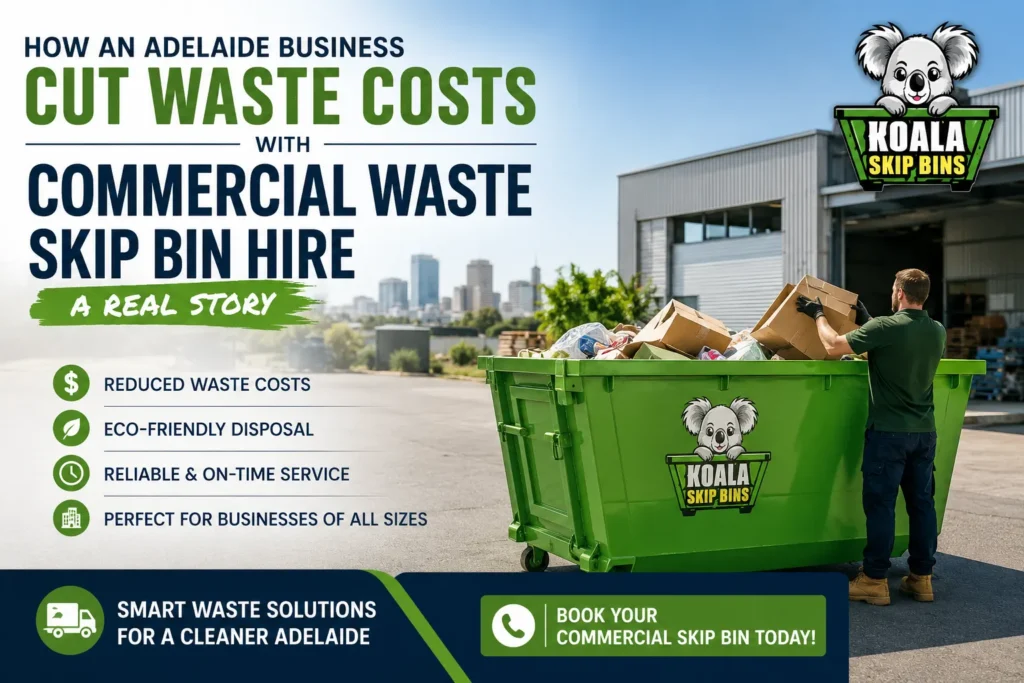
Commercial waste skip bin hire Adelaide is a fast way for local businesses to lower disposal costs. It replaces unpredictable per-bag or per-trip fees with a single, scheduled cost that scales with a business’s waste output. That’s exactly the shift one Adelaide business made this year, and it’s a story worth telling in full, because the mistakes and fixes along the way apply to almost any commercial site struggling with rubbish costs.
The Problem: A Warehouse Drowning in Council Bins
Marcus manages a mid-sized furniture store and warehouse in Adelaide’s west. Over eight years, his waste situation grew in bits and pieces. It started with a few council wheelie bins at the back of the site. For the larger waste loads, he kept using a local rubbish service when needed. On weekends, when things piled up, staff would sometimes drive the extra rubbish to the tip in their own utes.
It worked, more or less, until it didn’t.
In early 2026, Marcus had three different contacts for waste. They did not line up with each other. Cardboard from fresh deliveries kept stacking up. The council bins filled quicker than expected. Some cut pieces from a showroom job were left in a corner. They stayed there for about six weeks. No one pushed for a special pickup. Each time Marcus rang a removalist, the quote felt higher than last time. There was no set price. There was no agreement either.
Not long after, Marcus met with his bookkeeper and checked the figures. The yearly total came to a little over $14,000. That sum covered extra fees from council bins, one-off calls to removalists, and an estimate for the time staff spent dealing with it. It shocked him that no one had tallied it before. After the review, it was clear the way they handled waste was not working. It had turned into a string of last-minute problems.
Why Skip Bin Hire Made More Sense Than Council Bins
Marcus first had to fix one wrong idea. He thought skip bins were only for building jobs. That is not how it works in Adelaide. Businesses use them when they have waste that goes beyond what council bins can handle. Offices, warehouses, shops, cafes and restaurants, and tradespeople all rely on them in the same basic way.
The main difference is size and how you manage it. A regular council bin holds about 240 litres. A commercial skip bin is bigger. It can start at around 2 cubic metres, and it can rise to 30 cubic metres, sometimes more. That size can take in weeks’ worth of overflow. It also cuts down on extra collections. It helps when staff are stuck and cannot find a place for the rubbish.
Koala Skip Bins walked Marcus through a straightforward comparison:
| Factor | Council/Ad Hoc Removal | Commercial Skip Bin Hire |
| Pricing | Variable, rises with demand | Fixed quote per bin, agreed upfront |
| Capacity | 240L per bin | 2m³–30m³ per bin |
| Scheduling | Reactive, staff-dependent | Proactive, on a set roster |
| Waste sorting | Minimal, mostly landfill | General, mixed, and recyclable streams available |
| Admin time | High — multiple contacts | Low — single point of contact |
Setting Up a Scheduled Waste Collection System
Rather than a single big skip, the solution for Marcus’s warehouse was a scheduled waste collection plan: a mid-size skip bin delivered and swapped on a fortnightly rotation, sized to the warehouse’s average packaging and general waste volume, with a larger skip brought in during the two weeks of the showroom renovation.
This is a pattern that suits a lot of Adelaide businesses with predictable waste cycles — retail stores with regular stock turnover, offices doing periodic clear-outs, and warehouses managing packaging waste all benefit from a set collection rhythm rather than calling for a pickup every time a bin fills up.
The renovation waste was the trickier part. Office renovation waste removal and general construction and demolition waste disposal usually need to be handled separately from general commercial rubbish, both because of weight (plasterboard, tiles, and timber are heavy) and because councils and waste facilities often require these materials to be sorted differently for compliance and recycling purposes. Koala Skip Bins supplied a dedicated builder’s skip for the renovation period, kept entirely separate from the ongoing general waste skip, so neither stream slowed the other down.
The Numbers: What Changed
Six months after switching to a scheduled skip bin arrangement, Marcus ran the same cost audit.
- Annual waste spend dropped from roughly $14,000 to $9,200 — a reduction of about 34%, driven mainly by eliminating surge pricing from ad hoc removalist callouts.
- Staff time spent managing waste dropped sharply, since one supplier now handled scheduling, delivery, and swap-outs instead of three uncoordinated contacts.
- Recycling volume increased, because Koala Skip Bins separated general waste from recyclable material, something the previous ad hoc system never did.
- Zero missed pickups, compared to at least four instances in the prior year where overflow waste sat for a week or more waiting on a casual removalist’s availability.
The renovation skip alone- a single large-capacity bin instead of six weeks of piecemeal ute runs to the tip saved an estimated $1,800 in disposal fees and roughly 20 hours of staff time.
What Other Adelaide Businesses Can Learn From This
Marcus’s situation isn’t unusual. Most commercial waste cost blowouts come from the same three root causes: unpredictable pricing, no dedicated point of contact, and a mismatch between bin size and actual waste volume. Fixing all three tends to look the same regardless of industry.
Match the bin to the business, not the other way around. A business generating two skip-loads of waste a month doesn’t need a weekly service, and a business with sudden volume spikes (renovations, seasonal stock changes, office fit-outs) needs the flexibility to scale up temporarily without renegotiating a whole contract.
Separate waste streams where it saves money. Construction and demolition waste, general commercial rubbish, and recyclables often have different disposal costs per tonne. Mixing them into one skip usually means paying the highest applicable rate for everything in it.
Lock in a fixed rate before volume grows. Ad hoc pricing almost always rises with urgency. A scheduled contract fixes the rate regardless of how often demand spikes.
Industry Trends Shaping Commercial Waste in Adelaide
A few shifts are worth knowing about if you’re weighing up commercial skip bin hire for your own business:
- Landfill levies are rising. South Australia has raised its waste levy year after year. That has pushed up the price of sending general waste to landfill by the tonne. At the same time, skip services that focus on recycling feel like a better deal as the years go by.
- Businesses are being asked to report on waste diversion. Retail and logistics tenants are being asked by landlords or head offices to show how much waste they keep out of landfill. They want a set share to be diverted, not just dumped. This is driving more business toward skip firms that sort materials and pull out recyclables. Those providers send less to a general tip.
- Same-day and next-day delivery has become the norm. In Adelaide, the skip bin market is getting more competitive. Because of that, same-day delivery is now something many businesses expect, even when the waste needs to be handled right away. It is not treated as a special extra anymore.
- Large-capacity bins are increasingly used for staged projects. Instead of booking one big skip for the entire renovation, more commercial jobs are choosing several large skips and changing them in steps. This approach keeps the work area easier to use. It also helps avoid paying for space that is only partly used.
Practical Tips for Choosing a Commercial Skip Bin Provider
- Ask how pricing is structured, not just what the base rate is. Weight limits, extra tonnage fees, and prohibited-item surcharges are where costs quietly blow out.
- Confirm what happens to the waste after collection. A provider who can explain their recycling and sorting process is generally more transparent about pricing too — the two tend to go together.
- Check placement requirements before delivery day. Skip bins need clear, level access and enough space to be dropped and collected safely; sorting this out in advance avoids delivery delays.
- Get bin size guidance rather than guessing. Undersizing leads to overflow and extra callouts; oversizing means paying for capacity that never gets used. A good provider will ask about waste type and volume before quoting a size.
- Ask about scheduling flexibility. Businesses with seasonal or project-based waste spikes should confirm upfront how easily a scheduled service can flex up or down.
Frequently Asked Questions
What size skip bin does a small-to-medium Adelaide business typically need?
Most offices and small retail sites do well with a 3–4 cubic metre skip on a fortnightly or monthly schedule. Warehouses, hospitality venues, and businesses undergoing renovation typically need 6–15 cubic metres, and large construction or demolition jobs often require 20–30 cubic metre bins. The right size depends on waste type as much as volume bulky, low-density waste like cardboard fills a skip faster than dense material like rubble.
Is commercial skip bin hire cheaper than council bin collection for a business?
For low-volume waste, standard council collection can still be the cheaper option. Once a business regularly exceeds its council bin capacity and starts paying for excess collections or ad hoc removalist callouts, skip bin hire is usually cheaper on a per-tonne basis, because the pricing is fixed and doesn’t carry the same surge costs.
Can construction and demolition waste go in the same skip as general office or retail waste?
No, and mixing them is one of the most common ways businesses overpay. Construction and demolition waste often includes heavier materials that push a skip over its weight limit quickly, triggering extra fees, and many facilities process C&D waste differently for recycling purposes. Keeping renovation or building waste in a dedicated skip, separate from general commercial rubbish, keeps both cheaper.
What items usually can’t go in a commercial skip bin?
Most Adelaide skip bin providers won’t accept asbestos, hazardous chemicals, paint tins, batteries, tyres, gas bottles, or e-waste in a general skip. These typically require separate, licensed disposal. It’s worth confirming the exact list with your provider before loading a bin, since prohibited-item fees can be significant if they’re found during collection.
How quickly can a skip bin be delivered in Adelaide?
Same-day or next-day delivery is now standard for most Adelaide skip bin providers, including for commercial accounts, provided the booking is made before the daily cutoff (typically late morning). Businesses with recurring or scheduled needs generally get priority booking slots once a regular arrangement is in place.
Does using a skip bin service actually improve a business’s recycling rate?
It can, but only if the provider sorts waste streams rather than sending everything to general landfill. Ask specifically whether cardboard, metal, and green waste are separated and where they’re processed. Businesses that switch to a provider offering waste stream separation typically see a measurable increase in their diverted-from-landfill percentage, which matters increasingly for landlord or corporate sustainability reporting.
Is a contract or ongoing agreement necessary, or can bins be booked one at a time?
Both options are normally available. One-off bookings suit businesses with irregular or one-time waste needs, like a single office clean-out. A scheduled arrangement suits businesses with recurring waste and usually comes with better per-bin pricing since the provider can plan delivery routes and capacity.
The Bottom Line
Marcus’s story isn’t about finding a cheaper skip bin. It’s about replacing a reactive, uncoordinated waste system with a scheduled one that matches actual business volume. That shift is available to almost any Adelaide business currently relying on council bins stretched past capacity or a rotating cast of casual removalists.
Koala Skip Bins works with businesses across Adelaide, from warehouses and retail sites to offices and construction projects, to build a waste plan sized to what’s actually being generated, with fixed pricing and no surprise callout fees. If your business is spending more time and money managing waste than it should be, a waste audit conversation costs nothing and often reveals savings within the first month.
Recent Posts

About Me
Koala Skip Bins is Adelaide’s trusted waste management solution, providing reliable and affordable skip bin hire for residential, commercial, and industrial needs. We take pride in our eco-friendly approach, ensuring responsible waste disposal and recycling to reduce environmental impact. With a range of bin sizes, flexible hire options, and prompt delivery and pickup, we make rubbish removal hassle-free.



Sign up for our Newsletter
Click edit button to change this text. Lorem ipsum dolor sit amet, consectetur adipiscing elit